Civilian compensation · Military transition

Your first civilian compensation package is more than a salary.

After military retirement, a civilian paycheck can arrive alongside retired pay, VA disability compensation, a TSP, a new 401(k), bonuses, equity compensation, healthcare elections, and a different tax picture.

The First 90 Days Civilian Compensation Playbook helps senior military leaders slow the process down, see the whole package, and identify which decisions need to be coordinated.

Free 13-page PDF. Opens in a new tab. No email, form, or meeting required.

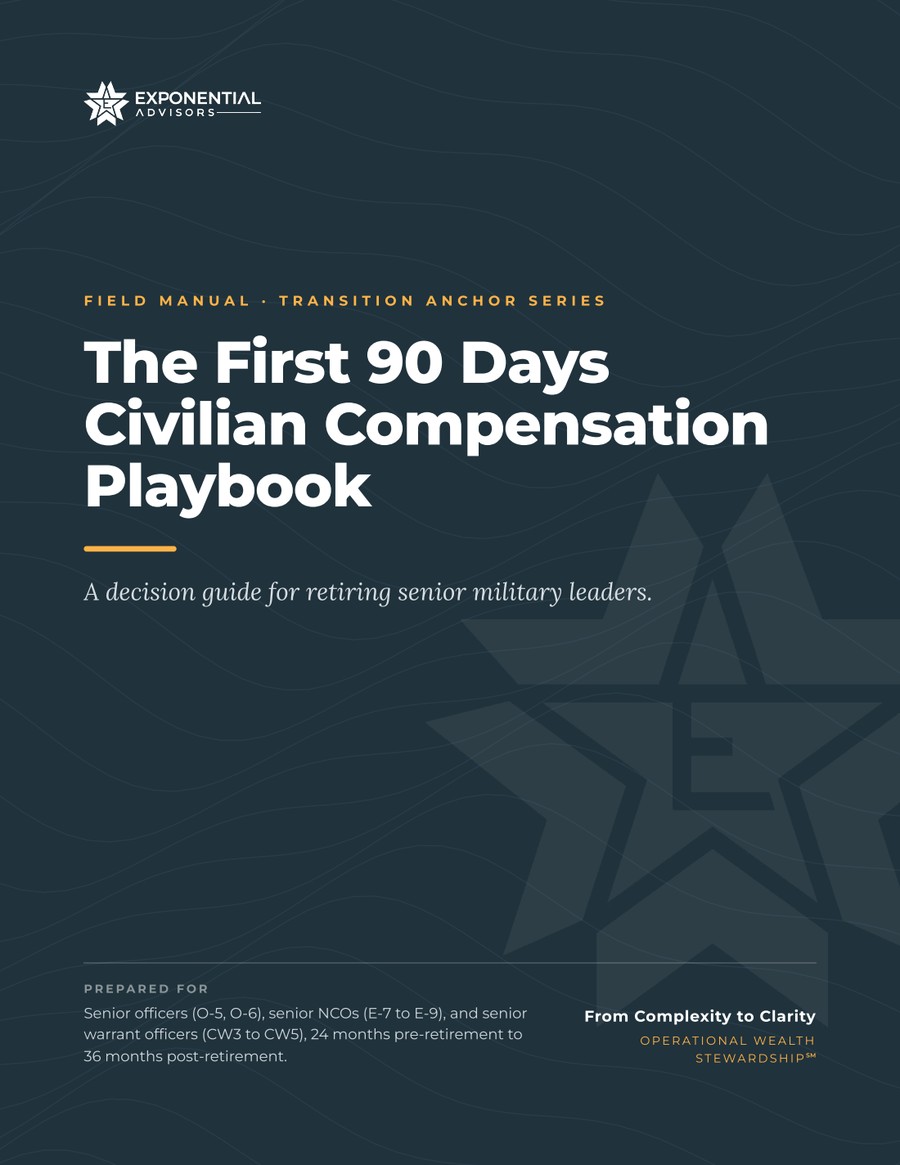
Cover of The First 90 Days Civilian Compensation Playbook, a decision guide for retiring senior military leaders from Exponential Advisors

13-page PDF · Free · No email or meeting required

What you'll work through.

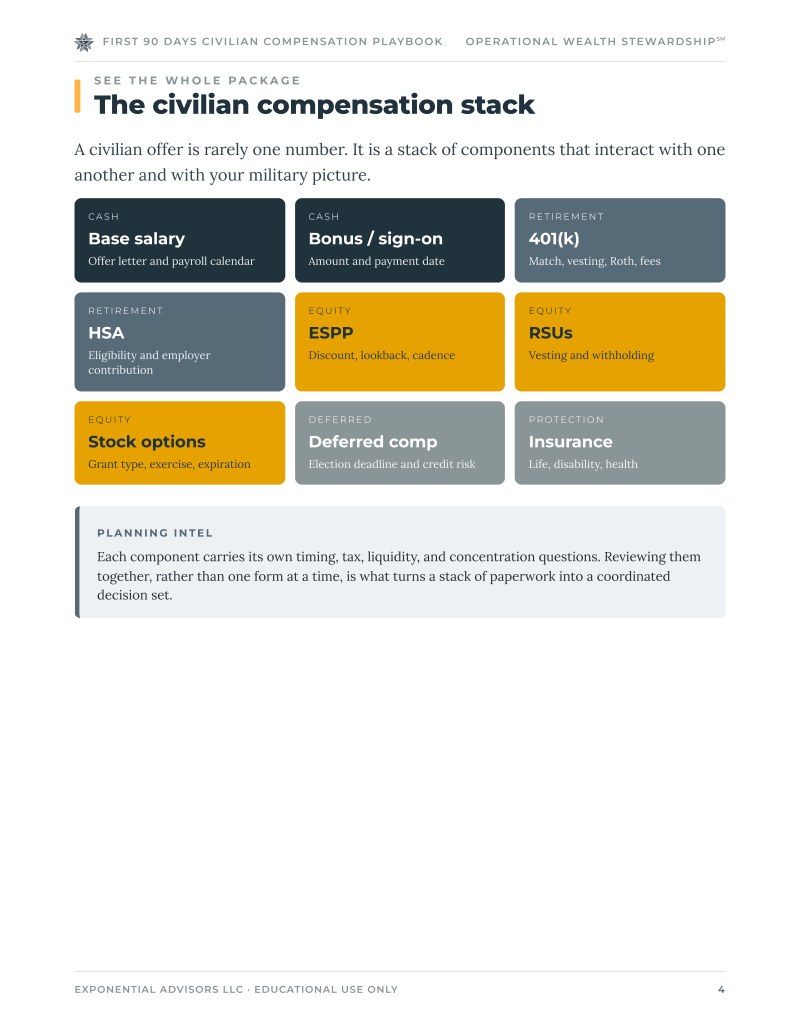
The playbook treats a civilian offer as a stack of components that interact with one another and with your military picture. Each one carries its own timing, tax, liquidity, and concentration questions.

  • Base salary and first-paycheck timing
  • Signing bonuses and annual incentives
  • Military retired pay and VA disability income
  • Employer 401(k) decisions
  • TSP coordination
  • HSA eligibility and employer contributions
  • ESPP considerations
  • RSUs, stock options, and other equity compensation
  • Deferred compensation elections
  • Health, life, and disability insurance
  • Tax withholding during the transition year
  • Beneficiary coordination across every account
  • Which questions belong with a CPA, attorney, benefits specialist, or fiduciary planner

Inside: a two-page decision worksheet, a fictional illustrative scenario, and source checks for every figure cited.

Download the Free Playbook

Educational decision aid. Not personalized investment, tax, or legal advice.

Page 4 of the playbook, The civilian compensation stack, showing cash, retirement, equity, deferred, and protection components

Page 4 of 13: the civilian compensation stack

Civilian compensation decisions arrive in sequence.

Most offer letters show compensation as a list. A transition household needs a sequence. The playbook organizes the first 90 days into three windows, each with its own set of questions.

01

Before accepting or starting

  • Obtain the offer letter and benefits guide
  • Ask when the 401(k), HSA, ESPP, deferred-comp, and equity plans become available
  • Flag salary, bonus, relocation, severance, non-compete, and equity terms that need attorney or tax review
  • Note which benefit elections must be made before the first paycheck
  • Confirm whether the employer plan accepts rollovers, if a TSP or IRA question exists

02

During onboarding

  • Set a temporary cash-flow map for pension, VA disability, salary, and bonus timing
  • Review federal withholding after the first paycheck or pension payment
  • Decide whether an HSA-eligible plan fits the household
  • Map equity vesting, exercise windows, ESPP purchase dates, and trading-window rules
  • Document beneficiaries across the TSP, employer plan, life insurance, and other accounts

03

During the first quarter

  • Revisit contribution elections once real payroll data arrives
  • Decide whether TSP questions should wait for clearer civilian-plan details
  • Route items to a CPA, attorney, or benefits specialist
  • Confirm liquid reserves before using bonus, equity, or taxable assets for long-term plans
  • Build a transition-year tax calendar

Command decision

Separate the decisions with fixed deadlines from the decisions that improve once real payroll and pension data exist. Speed on the wrong item is not progress.

Working in defense after the military?

Many senior military leaders move into aerospace, defense, engineering, program management, and leadership roles. The compensation that comes with those roles introduces decisions the military never asked you to make.

Lockheed Martin

Entering Lockheed Martin after military retirement

  • Coordinating military retired pay and VA compensation with a new civilian salary and bonus
  • Employer 401(k) elections alongside an existing TSP, including whether the plan accepts rollovers
  • HSA eligibility and health-plan elections beside coverage the household already carries
  • Equity compensation, employer-stock concentration, and vesting calendars
  • Deferred-compensation elections for eligible executives, and pension questions where a legacy benefit applies
  • Transition-year withholding when several payers each withhold as if alone

Exponential Advisors LLC is not affiliated with, sponsored by, or endorsed by Lockheed Martin Corporation. Plan provisions vary by employee group and change over time; confirm yours in your current plan documents and benefits portal.

Bell Textron (Bell Helicopter)

Civilian compensation after military retirement at Bell

  • Retirement-income coordination: retired pay, VA compensation, and a civilian paycheck on one cash-flow map
  • 401(k) decisions alongside the TSP, and pension coordination where an employee is eligible
  • HSA decisions and health, life, and disability coverage elections
  • Textron equity compensation and ESPP considerations, including concentration in employer stock
  • Career-transition cash reserves before bonus or equity is committed to long-term plans
  • Withholding and a transition-year tax calendar

Exponential Advisors LLC is not affiliated with, sponsored by, or endorsed by Bell Textron Inc. or Textron Inc. Plan provisions vary by employee group and change over time; confirm yours in your current plan documents and benefits portal.

Company names are used for identification only. Exponential Advisors LLC is not affiliated with, sponsored by, or endorsed by Lockheed Martin Corporation, Bell Textron Inc., or Textron Inc.

One household. Three connected decisions.

A civilian offer is one corner of the Decision Triangle℠. The SBP election comes through retirement processing. TSP choices often come through an adviser or a rollover form. The offer arrives from HR.

Each enters through a different door, and each can change the other two. A civilian 401(k) can change the TSP question. Civilian pay and bonus timing can change the first two tax years.

Survivor-income planning shifts with every new source of household income. Operational Wealth Stewardship℠ is the firm's discipline of deciding them together, in sequence, with the family in the room.

See how the three decisions connect →

Written by a planner who understands the military side of the decision.

Joshua Brooks, CFP®, is the founder of Exponential Advisors LLC, a fee-only fiduciary firm in Weatherford, Texas. He is an Army veteran and actively serving Army Reserve chaplain, 22 years and counting in uniform.

He works with military retirees, transitioning senior leaders, veterans, and professionals moving into the defense industry. He also answered the Lockheed Martin and Bell Textron Q&A features on Wealthtender.

The playbook is written the way he works: you are the one making the decision, and the job is to make the whole package visible before anything is signed.

CFP® professionalFee-only fiduciaryArmy veteranArmy Reserve chaplain
More About Joshua

Questions military retirees ask about civilian compensation.

Short, general answers drawn from the playbook. None of them is advice for your situation.

What should a military retiree review in a civilian compensation package?

More than base salary: bonus terms and payment dates, 401(k) eligibility and match, HSA eligibility, equity vesting, deferred-compensation deadlines, insurance elections, and withholding once salary joins retired pay.

Can I contribute to a civilian 401(k) after contributing to the TSP?

Generally yes, but the IRS employee deferral limit is shared across 401(k), 403(b), and TSP contributions in the same year, so TSP deferrals count toward it. Whether the plan accepts a TSP rollover is a separate question.

How do military retired pay and a civilian salary affect tax withholding?

Each payer generally withholds as if it were your only income, so a year mixing retired pay, salary, bonus, and equity income can end up under-withheld. Check withholding after the first paycheck and first pension payment.

What should I look for in an executive compensation package after military retirement?

Beyond salary and bonus: equity grant type and vesting, deferred-compensation deadlines and employer credit risk, non-compete and severance terms, and benefit eligibility dates. Several may need attorney or tax review.

How should I think about RSUs or employer stock after leaving the military?

RSUs, restricted stock, options, and ESPP shares differ in vesting, tax, liquidity, and concentration. Ask when shares vest, how taxes are withheld, when trading windows open, and how much net worth sits in one stock.

When should I review my civilian benefits after starting a new job?

In three windows: before accepting or starting, for deadline-driven elections; during onboarding, for cash flow, withholding, health plan, and beneficiaries; and in the first quarter, once real payroll data exists.

The playbook gives you the framework.

If your package raises questions specific to your pension, TSP, employer benefits, equity compensation, taxes, or family, the next step may be a structured planning conversation.

Educational disclaimer

This material is provided for informational and educational purposes only and does not constitute investment, tax, legal, benefits, or insurance advice.

Nothing on this page or in the playbook is a recommendation to accept an employment offer, elect a benefit, exercise an option, sell employer stock, change a retirement-plan election, or make any tax election.

Exponential Advisors LLC does not provide tax or legal advice. Consult your tax professional or attorney before making decisions about your compensation.

Advisory services offered through Exponential Advisors LLC, an investment adviser registered with the state of Texas. Advisory services are only offered where Exponential Advisors and its representatives are properly registered or exempt from registration.

Advisory services offered through Exponential Advisors LLC, an investment adviser registered with the state of Texas, and only where properly registered or exempt.

Read full disclosures